Designer Diary 1: Siberian Manhunt
CONCEPT
I think we can all agree that global pandemics suck. But for all the misery that came out of COVID-19, there were a few small bright spots; and one of them was the inception of Siberian Manhunt.
By the end of 2020, we were deep into our third lockdown in Berlin, and my wife and I had burned through all of our light two-player games. We yearned for something meatier—but still something that could be finished in a single evening, since our board games and dinners shared the same real estate.
At the time, I was reading Louis L’Amour’s classic novel Last of the Breed, a harrowing adventure about a U.S. Air Force test pilot captured by the Soviets in the late ’80s. A Native American and a survivalist, he escapes his captors and flees across the unforgiving Siberian wilderness with the KGB in pursuit. It’s a ripping good yarn, and I highly recommend it.
“Someone should turn this into a movie,” I told my wife one evening before bed. “Or a Netflix series. Or a board game.”
Bingo.

Siberian Manhunt cover by Maciej Jenik
That night I lay awake in bed, staring at the darkened ceiling, puzzling out the rules of my nascent brainchild. Naturally, it would be a two-player game: a fugitive on the run from the Soviets. It would need to be asymmetrical, with the Fugitive dealing with the daily trials of life on the run, while the Government carried out the titular manhunt using almost unlimited Soviet resources—albeit with a few communist inefficiencies to keep things interesting. And finally, a manhunt practically demanded a hidden movement mechanic; after all, the Soviets wouldn’t necessarily know where the fugitive was. Once I scribbled down the basic framework of the rules, I fell asleep thinking about fleeing through the Taiga. It was not my most restful night.
PROTOTYPE
I got to work on a prototype the next day. This was not my first rodeo, so I applied a few lessons learned from my previous (unsuccessful) forays into board game design:
-
Write down all the rules in Excel and try to numerically balance the game there as much as possible.
-
Don’t waste time with artwork at the early stage. The game had to work mechanically first.
-
Avoid physical prototypes at an early stage, as the printing and crafting can become expensive and slow the development process. I used Tabletop Simulator (TTS) for all my early playtests.
My first map was built from Google Maps screenshots of the Baikal region of Siberia. I overlaid roads and towns using real geography as a guide, then added numbered locations that the Fugitive and Government agents would move through.

The map prototype based on Google Maps
GAME DESIGN
Although Siberian Manhunt would be asymmetrical, the basic game loop would be the same for both players:
Recover energy → Spend energy on actions → Clean-up
Where the roles diverged was in the actions themselves. I wanted the Fugitive’s experience to feel authentic: always on the move, low on supplies, unsure who to trust, and increasingly desperate. Their turns revolved around hidden movement, scavenging for food and equipment, hunting, crafting, and interacting with locals and wildlife. The Fugitive secretly recorded their exact locations, while a Hidden Movement Track publicly logged how far they’d traveled since they were last seen.
Each turn began with an Encounter card, allowing me to introduce narrative challenges. A Wilderness Deck provides animals to hunt and crafting components, while an Urban Deck supplies equipment from towns. Energy would be recovered in different ways: in the wilderness, the Fugitive regained only one meager point of energy per turn.
In towns, however, they recovered fully—making towns tempting, useful, and potentially very dangerous if the locals decide to report them. The Fugitive could eat food to boost their energy at any time (meat could be obtained from hunting, but would need to be cooked or else the Fugitive would face a parasite risk).
Each turn began with an Encounter card, allowing me to introduce narrative challenges. A Wilderness Deck provides animals to hunt and crafting components, while an Urban Deck supplies equipment from towns. Energy would be recovered in different ways: in the wilderness, the Fugitive regained only one meager point of energy per turn. In towns, however, they recovered fully—making towns tempting, useful, and potentially very dangerous if the locals decide to report them. The Fugitive could eat food to boost their energy at any time (meat could be obtained from hunting, but would need to be cooked or else the Fugitive would face a parasite risk).
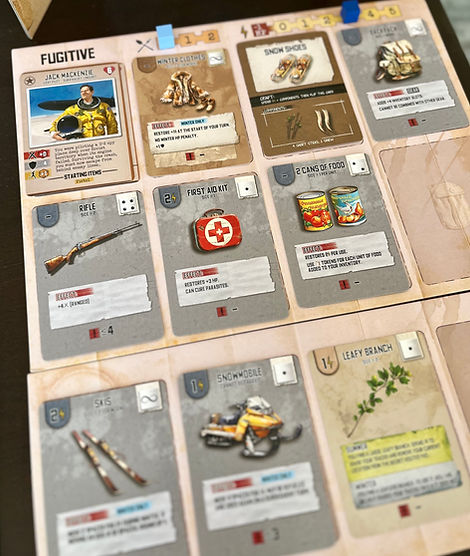
The Fugitive player board

The Government player board
The Government’s role was simultaneously more concrete and more abstract than the Fugitive’s. The Government had physical pawns on the map, little KGB officers scouring the countryside for an ephemeral Fugitive. These pawns could move and search, attack the Fugitive if they found him, or capture him if two KGBs could get to the Fugitive’s location at the same time. Agents could also be upgraded into elite Yakut Trackers, who moved faster and could race across the map much like the Fugitive. At the start of each turn, the Government’s energy would be reset to be equal to the number of agent pawns on the map.
But the real engine of the Government was the Assistance Deck–resources from the central Soviet Government which provided powerful, one-time effects to help the KGB track down the Fugitive: aerial searches, checkpoints, helicopter transports, propaganda campaigns, and, most importantly, new recruits. Recruit cards added more pawns to the board and permanently increased the Government’s available energy:
more pawns = more energy = more actions.
To model the attitudes of the local population, I initially created a Manhunt Deck filled with Loyal Communist and Silent Citizen cards. Each time the Fugitive entered a town, a card was drawn. Silent Citizens kept quiet while Loyal Communists immediately reported the Fugitive’s position. The Fugitive’s decisions influenced the deck’s makeup: heroic behavior added Silent Citizens, while killing and pillaging produced enthusiastic informants. Government actions, such as interrogations or propaganda campaigns, could also shift the balance. Eventually, I replaced the deck with a draw bag, which proved far more practical than reshuffling a deck many times per game.

The initial Manhunt Deck (TTS version)

The final Manhunt Bag
Finding artists was surprisingly easy. I wanted a realistic, painterly style and searched portfolios on BGG and ArtStation. I found the cover of Stroganov particularly compelling and reached out to the artist, Maciej Janik. After a TTS playtest, he was enthusiastically onboard with Siberian Manhunt. I found the rest of the team the same way: Natalie Henderson, Radu Paul Mazanac, and JD Rodriguez.
THEME
Thematically, I wanted to avoid Louis L'Amour's kidnapped pilot plot. Therefore, I initially considered making the Fugitive an escapee from a Soviet gulag, but Maciej rightly pointed out that the gulag system was horrific, and the game wasn’t about that. I turned instead to the Gary Powers U-2 incident. In 1960, Powers’ spy plane was shot down over the USSR. He survived, was captured, and spent nearly two years imprisoned before being released in a prisoner exchange.
What if he’d escaped immediate capture and gone on the run instead?
That question became the heart of Siberian Manhunt. The Fugitive became a U-2 pilot, downed behind enemy lines and fleeing into the wilderness on foot.

Francis Gary Powers and his U-2
Later, I met Francis Gary Powers Jr., son of the U-2 pilot, who provided wonderful historical insights—and told me that Louis L’Amour had been a family friend, and that Last of the Breed was inspired by his father’s experience. In a small but satisfying way, it felt like Siberian Manhunt was closing a loop.

Gary Powers Jr. and I at the Checkpoint Charlie Mueseum in Berlin
BALANCE
Balancing the game proved surprisingly challenging. In theory, it should have been straightforward: make food more plentiful to help the Fugitive, or add more Recruit cards to help the Government. In practice, everything affected balance—encounter difficulty, map density, town placement, card effects, and more.
Balancing the game proved surprisingly challenging. In theory, it should have been straightforward: make food more plentiful to help the Fugitive, or add more Recruit cards to help the Government. In practice, everything affected balance—encounter difficulty, map density, town placement, card effects, and more.
I initially aimed for a perfectly even 50–50 win rate. It turned out that an even-balance produced dull games: when the Fugitive was too strong, they disappeared into the map for an anti-climactic win. The sweet spot ended up being a 40–60 win ratio in favor of the Government. That intentional imbalance created tense games where the Fugitive was constantly under pressure.
The balance during each game shifts too. The Government begins in a weak postion—just one lonely KGB agent on the board. The Fugitive also starts out weak but can quickly grow stronger with equipment from nearby towns. As the game progresses, however, the Fugitive is gradually worn down by life on the run while the Government steadily grows stronger. By the time the Fugitive reaches the border region, wounded and low on supplies, the Government is usually at peak power, leading to tense, climactic showdowns just short of the Chinese border.

The endgame of Siberian Manhunt: KGB agents at the border
The game was extensively playtested, first on TTS and later in physical form. Every playtest was valuable—right up until the feedback started contradicting itself. For example, one regular tester hated crafting and wanted it removed entirely. Others loved it and wanted more. At that point, I just had to trust my gut and make the game I wanted to play. And hundreds of plays later, I still enjoy it—especially how each session organically creates a unique, often cinematic Cold War survival story.
CONVENTIONS AND KICKSTARTER
We took Siberian Manhunt on the road, demoing it at SPIEL ’23, UK Game Expo ’24, and SPIEL ’24. The theme made it somewhat of a niche game, but those who appreciated the Cold War and survival vibes embraced it enthusiastically. In February 2025 we launched Siberian Manhunt on Kickstarter. The campaign was a lot of fun, with great backer interaction and plenty of lessons learned. Because the game was essentially complete before launch, and with manufacturing by LongPack Games already lined up, we were able to move into production by June and wrap fulfillment in November. We attended SPIEL in 2025 again, but this time—finally!—with copies of the game to sell.

Demoing at UK Games Expo 2024
I’m now hard at work on the sequel-expansion, Manchurian Manhunt, which explores what happens when the Fugitive crosses the Chinese border and the chase gets bigger, faster, and even less forgiving.
But that’s a story for another diary.